

Habitat and Range
The African Bush Elephant occupies one of the widest ecological ranges of any terrestrial mammal, dispersing across a vast mosaic of sub-Saharan landscapes. Historically, their distribution stretched continuously from the Sahel to South Africa and from West Africa to East Africa’s coastal forests.
Today, their range is far more fragmented, shaped by habitat loss, human expansion, and shifting ecological conditions. Despite these pressures, Loxodonta africana remains highly adaptable, thriving in an impressive variety of environments. Bush elephants inhabit savannas, woodlands, floodplains, miombo forests, mopane scrub, desert-edge ecosystems, and mixed grassland–forest mosaics.
Habitat
The habitat selection of the African bush elephant is strongly influenced by access to water, forage availability, and seasonal ecological patterns. In regions such as Botswana, Namibia, and Tanzania, elephant movements track seasonal water sources, often covering hundreds of kilometres between dry-season refuges and wet-season feeding grounds. Below are the different habitat types demonstrated.
Click on each habitat type for more information.


Savanna Woodland
Forests


Open Grassland
Floodplains and Wetlands

Miombo and Mopane
Woodlands

Desert and Semi-Desert Ecosystems
Habitat Pressures
African bush elephants face increasing habitat pressures across their range due to expanding human land use, climate variability, and fragmentation of natural ecosystems. As elephants require large, connected landscapes to meet their needs for food, water, and seasonal movement, even moderate habitat disturbance can significantly affect their survival and behaviour. Loss of key habitats, particularly migration corridors, riverine systems, and high-quality dry-season feeding areas, can lead to nutritional stress, increased human–elephant conflict, and population declines. The pressures below represent the most significant threats affecting elephant habitats today.
Key Threats to Elephant Habitat

Range
The African Bush Elephant once roamed across almost the entire sub-Saharan continent, from the Sahel to the southern woodlands. Today, their range is far more fragmented. Modern populations occur in a patchwork of protected areas, transfrontier landscapes, and isolated ecosystems shaped by human settlement, agriculture, and habitat loss.
Despite this contraction, elephants still occupy a remarkable diversity of environments such as savannas, woodlands, deserts, and floodplains, where they play a vital ecological role. Understanding both their current and historical distribution is essential for guiding conservation action, restoring connectivity, and ensuring their long-term survival.
Click below to learn more about the different regions elephants inhabit
Southern Africa
Overview
Southern Africa supports some of the largest and most stable populations of the African bush elephant (Loxodonta africana). The region’s vast savannas, protected areas, and well-established transboundary conservation landscapes have created strongholds for the species, particularly compared to other parts of the continent.
However, the region also reflects the long-term impacts of land conversion, historical overhunting, and localised habitat fragmentation.

Source: IUCN Red List of Threatened Species™. Map © IUCN
Click map to enlarge
Eastern Africa
Overview
In East Africa, the African Bush Elephant (Loxodonta africana) ranges across some of the region’s most iconic landscapes, including Kenya, Tanzania, Uganda, and parts of Ethiopia.
Although their historical range was far larger and more connected, significant populations remain today in ecosystems such as Amboseli, Tsavo, the Serengeti–Mara, Ruaha–Rungwa, and Queen Elizabeth National Park.
Elephants here rely on varied habitats from grasslands, acacia woodlands, to seasonal wetlands, and are known for long-distance movements driven by rainfall and resource availability. Maintaining cross-border connectivity is crucial, as these movements support both ecological function and long-term population health.

Source: IUCN Red List of Threatened Species™. Map © IUCN
Click map to enlarge
Central and West Africa
Overview
In West and Central Africa, African Bush Elephants (Loxodonta africana) occupy a far more fragmented and reduced range than in the past, surviving mainly in protected areas across countries such as Gabon, Cameroon, the Central African Republic, Republic of Congo, and parts of Mali and Burkina Faso.
Historically widespread across the region’s savannas and forest–savanna mosaics, their distribution has contracted sharply due to habitat loss, poaching, and human expansion.Today, remaining populations depend on pockets of suitable habitat and the protection offered by national parks and transboundary landscapes. Maintaining and restoring habitat connectivity is essential to stabilise these small, isolated populations and ensure their long-term viability.
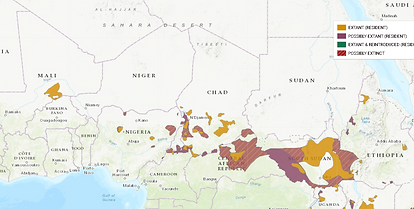
Source: IUCN Red List of Threatened Species™. Map © IUCN
Click map to enlarge
Download
Up-to-date range data for the African bush elephant are available on the IUCN Red List of Threatened Species™ website. These maps and datasets are provided for non-commercial research and educational use only. Download available in top right corner under "Download". All map data remain the property of the IUCN and may not be modified.
