
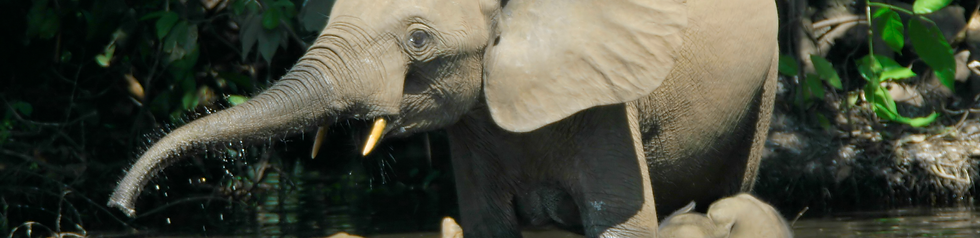
Social Structure
The African forest elephant exhibits a complex, kin-based social system that shares many similarities with that of the African bush elephant, although it is typically less cohesive and more fluid due to the constraints of dense forest environments. Females remain within their natal groups for life, forming small, matriarch-led family units, while males disperse during adolescence and adopt more solitary or loosely associated lifestyles. This social organisation supports information transfer, spatial memory, and decision-making, particularly in navigating vast forest landscapes and locating critical resources such as fruiting trees and bais.
Matriarchal family structure
Forest elephant society is centred on small, matriarchal family units composed of related adult females, sub-adults, and calves. These groups are typically smaller and less frequently observed than those of savanna elephants, reflecting the challenges of living in dense forest. The matriarch plays a key role in guiding the group to feeding areas, water sources, and mineral-rich clearings, relying heavily on long-term spatial memory. While fission–fusion dynamics do occur, they are generally less pronounced, with interactions between groups often taking place at bais or along shared movement pathways.

Bulls
Adult male forest elephants follow a different social trajectory from females. After leaving their natal groups, they become largely solitary, though they may form loose, temporary associations with other males or congregate at resource-rich sites such as bais. Compared to savanna elephants, male interactions are less frequently observed, but evidence suggests they maintain social awareness and may engage in indirect communication over distance. As with other elephant species, male behaviour is influenced by musth, which plays a significant role in reproductive competition.

Mentor / old bulls (role of mature males)
Older bulls are believed to play an important, though less visible, role in forest elephant social systems. In environments where direct observation is difficult, emerging research suggests that experienced males contribute to social stability and may influence the behaviour of younger bulls, particularly in shared spaces such as bais. The loss of mature males through poaching can therefore have broader social consequences, potentially disrupting behavioural norms and reducing the transfer of ecological knowledge.

Young bulls (adolescents & bachelor groups)
Young male forest elephants typically disperse from their natal groups during adolescence and begin a more independent phase of life. They may form loose associations with other young males or intermittently associate with older bulls, particularly in areas where resources are concentrated. These interactions are important for developing social and reproductive behaviours. However, as dispersing individuals, young bulls are especially vulnerable to threats such as poaching and habitat fragmentation, which can affect both survival and social development.

Social Structure Literature
Below is a selection of current literature on social structure. More resources are available in our literary database.