
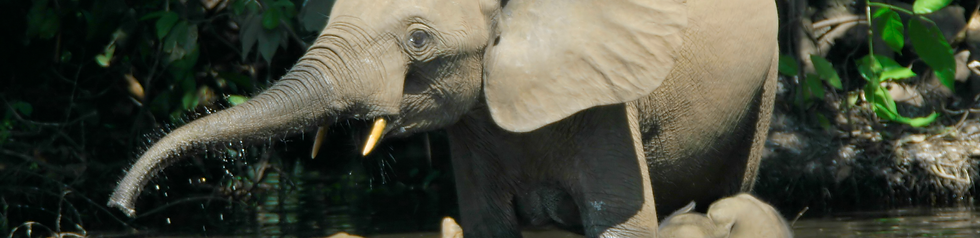
Habitat and Range
The African forest elephant inhabits the dense tropical rainforests of Central and West Africa, with its range historically spanning countries such as Gabon, Republic of the Congo, Cameroon, and parts of Democratic Republic of the Congo. These elephants are highly adapted to life in closed-canopy forests, favouring areas with dense vegetation, access to water, and mineral-rich clearings known as forest bais.
Their range is largely determined by the availability of food resources, seasonal fruiting patterns, and the presence of these critical clearings, which serve as important social and nutritional hubs. Although historically widespread, their current distribution has become increasingly fragmented due to habitat loss and human pressures, restricting many populations to protected or remote forest areas.
Habitat
The habitat selection of the African forest elephant is strongly influenced by the availability of fruiting trees, access to water, and the presence of mineral-rich clearings known as bais. Within the dense forests of countries such as Gabon, Republic of the Congo, and Cameroon, their movements are shaped by seasonal fruiting patterns and the distribution of key resources, often following well-established forest pathways over large areas. Unlike their savanna counterparts, forest elephants navigate a complex, closed-canopy environment, relying on spatial memory to locate feeding sites and bais that serve as essential social and nutritional hubs.
Click on each habitat type for more information.

Primary Tropical
Rainforest

Forests Clearing (Bias)
Forest-Savanna Mosaics

Swamp Forest and Flood Plains
Habitat Pressures
The habitat of the African forest elephant is increasingly under pressure from a combination of human-driven and environmental factors. Across Central and West Africa, expanding infrastructure, extractive industries, and land conversion are fragmenting once-continuous forests into isolated patches, disrupting traditional movement patterns and reducing access to critical resources such as fruiting trees and mineral-rich bais. These pressures not only diminish habitat quality but also increase the likelihood of human–elephant conflict and expose elephants to heightened risks such as poaching. As a result, even in areas where forest cover remains, the ecological integrity and connectivity required to sustain viable forest elephant populations are steadily declining.
Key Threats to Elephant Habitat

Range
The African forest elephant is found within the tropical forests of Central and West Africa, where it occupies some of the most dense and remote forest ecosystems on the continent. Its current range includes strongholds in countries such as Gabon and Republic of the Congo, with additional populations in Cameroon, Central African Republic, and parts of the Democratic Republic of the Congo. Smaller and increasingly isolated populations persist in West African countries such as Ivory Coast and Ghana.
Historically, forest elephants ranged across a far broader expanse of continuous rainforest. However, widespread habitat loss, fragmentation, and poaching have significantly reduced and divided their distribution. Today, many populations are confined to protected areas or remote forest blocks, often separated by human-dominated landscapes that limit movement and genetic exchange. Despite these challenges, the remaining range of forest elephants still represents one of the most important strongholds for biodiversity in Africa, making its protection critical for both the species and the ecosystems they support.
Click below to learn more about the different regions elephants inhabit
Central and West Africa
Overview
Central and West Africa support the remaining strongholds of the African forest elephant, where vast tracts of tropical rainforest still provide critical habitat for the species. Countries such as Gabon and the Republic of the Congo are particularly important, harbouring some of the largest remaining populations within relatively intact forest landscapes. Compared to other regions, these dense and often remote environments have historically offered a degree of natural protection.
However, the region also reflects the severe impacts of commercial poaching, expanding infrastructure, and ongoing forest degradation. Even within seemingly intact forests, increasing human access and habitat fragmentation are isolating populations and undermining long-term ecological stability.

Source: IUCN Red List of Threatened Species™. Map © IUCN
Click map to enlarge
Download
Up-to-date range data for the African forest elephant are available on the IUCN Red List of Threatened Species™ website. These maps and datasets are provided for non-commercial research and educational use only. Download available in top right corner under "Download". All map data remain the property of the IUCN and may not be modified.
