
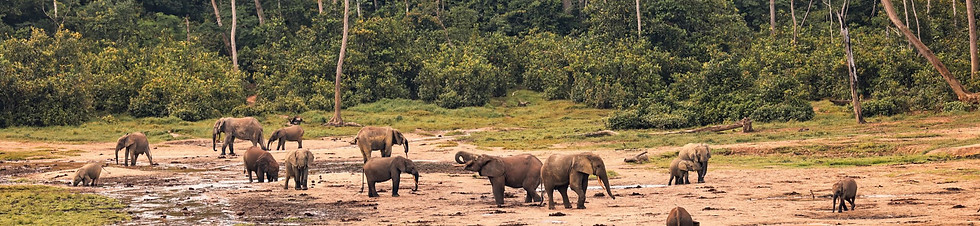
Ecological Engineers
African Forest Elephants as Ecological Engineers
Forest elephants, particularly the African forest elephant, play a foundational role in shaping the structure, composition, and functioning of Central and West African rainforests. Their influence extends far beyond simple herbivory; they are true ecological engineers whose daily movements and feeding behaviour actively construct and maintain the forest ecosystem itself.
Unlike many large mammals whose ecological roles are relatively localised, forest elephants operate at landscape scale. Through feeding, seed dispersal, trampling, mineral excavation, and long-distance movement, they regulate forest regeneration, biodiversity patterns, and even carbon storage capacity.
1. Forest Structure and Gap Dynamics
One of the most important roles forest elephants play is in shaping forest structure.
As they move through dense rainforest, elephants naturally create and maintain:
-
Trails through understory vegetation
-
Gaps in canopy-dense areas through feeding on saplings and small trees
-
Micro-openings that allow light penetration to the forest floor
These disturbances are not random damage—they are part of a continuous regeneration cycle. By breaking vegetation and opening space, forest elephants maintain a shifting mosaic of forest patches at different stages of succession.
This is especially important in closed-canopy rainforests where light is a limiting factor. Without elephant activity, forests can become overly uniform, reducing habitat diversity for other species.
2. Seed Dispersal: The Megafaunal Network
Forest elephants are among the most important seed dispersers in Africa. Their role is not just incidental—it is irreplaceable for many tree species.
They consume large quantities of fruit from a wide range of canopy and understory trees, often swallowing seeds whole and transporting them over distances ranging from hundreds of metres to several kilometres.
Key ecological functions include:
-
Long-distance dispersal: Seeds are transported far beyond the parent tree, reducing competition and increasing genetic mixing.
-
Germination enhancement: Passage through the elephant digestive tract can weaken seed coats, improving germination rates for some species.
-
Maintenance of large-seeded trees: Many rainforest trees have fruits too large for smaller animals to disperse effectively, these species are disproportionately dependent on elephants.
Without forest elephants, many of these trees face reduced recruitment, leading to long-term shifts in forest composition.
3. Nutrient Cycling and Soil Fertility
Forest elephants significantly influence nutrient dynamics across the forest floor.
Through feeding and movement, they:
-
Transport nutrients from fruiting trees to distant locations via dung
-
Concentrate mineral-rich dung in specific areas, creating nutrient hotspots
-
Dig into soils and termite mounds in search of minerals, redistributing subsoil nutrients to the surface
Their dung is particularly important in rainforest systems where soils are often nutrient-poor and heavily leached. Elephant dung supports:
-
Seedling growth
-
Insect populations (especially dung beetles)
-
Fungal and microbial communities essential for decomposition
In this way, elephants function as mobile nutrient distributors, connecting different parts of the forest ecosystem.
4. Carbon Storage and Climate Regulation
One of the most significant recent discoveries in tropical ecology is the role of forest elephants in carbon storage.
By selectively feeding on fast-growing, low-wood-density trees, elephants indirectly favour slow-growing, dense-wood species that store more carbon over time.
In ecological terms, they:
-
Suppress dominance of low-carbon-storing vegetation
-
Promote high wood-density tree species
-
Maintain forest structure that enhances long-term carbon sequestration
This means forest elephants contribute not only to biodiversity, but also to climate stability. Their loss leads to forests that store significantly less carbon per hectare.
5. Keystone Interactions and Biodiversity Cascades
Forest elephants are a classic example of a keystone species: their ecological influence is disproportionately large relative to their abundance.
Their presence affects:
-
Plant community composition
-
Availability of food resources for other herbivores
-
Habitat structure for birds, primates, insects, and amphibians
-
Predator–prey dynamics indirectly through habitat modification
When elephants are removed, ecosystems do not simply lose one species, they begin to reorganise. This often leads to:
-
Decline in large-seeded tree species
-
Reduced habitat heterogeneity
-
Lower overall biodiversity
-
Simplification of forest structure
These cascading effects can take decades to fully manifest but are difficult to reverse once established.
6. Landscape Connectivity and Memory
Forest elephants also act as long-term “memory carriers” of the forest landscape.
Because they travel along traditional routes across generations, they:
-
Maintain ancient migratory corridors
-
Connect isolated forest patches
-
Facilitate genetic exchange between plant populations
-
Influence spatial patterns of regeneration over decades
These movement networks are not random, they represent inherited ecological knowledge encoded in elephant societies and passed through matrilineal groups.
7. The Consequences of Loss
The decline of forest elephants has already triggered measurable ecological changes across Central and West Africa.
Without them:
-
Forests become less diverse
-
Carbon storage capacity declines
-
Tree species composition shifts toward smaller-seeded, fast-growing species
-
Regeneration patterns become less dynamic
-
Entire ecological networks begin to unravel
Because forest elephants are slow-breeding and heavily impacted by poaching and habitat loss, recovery of their ecological role is extremely slow even if populations begin to stabilise.
Forest elephants are not just inhabitants of the rainforest, they are architects of it. Every path they walk, every fruit they consume, and every seed they disperse contributes to the long-term structure and resilience of one of the most important ecosystems on Earth.
To lose forest elephants is not simply to lose a species. It is to lose an ecological process that has shaped African rainforests for millions of years.